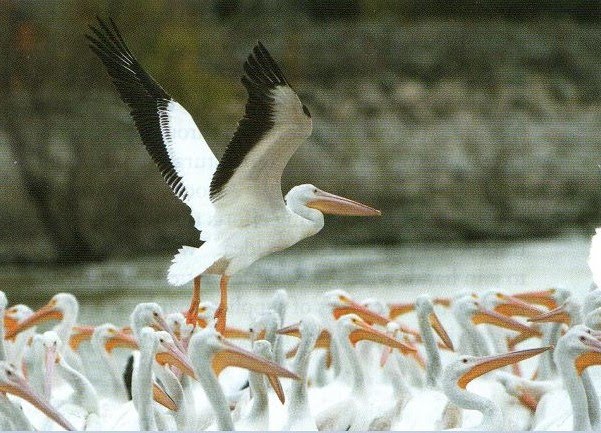
What do ya think????
Tuesday, April 5, 2011
Monday, April 4, 2011
The Eaglet Has Landed |: (
Yesterday, I was showing the EagleCam website to a friend and as we zoomed in close Daddy E got off the nest...it was very warm here for an early spring day. I think he was airing out his privates and giving the kids a chance to breath fresh air. Or...the older of the two eaglets was nipping him from below because of hunger. Anyway, as he leaned over the fresh kill in the nest, the little pip closed his beak on what appeared to be a feather under Daddy E's beak. When Daddy E jerked back his head to rip off a piece of entrails, he accidentally flung Junior #1 out of the bowl of the nest. Junior #1 is only 36 hours old, so there was no way he could climb up and over the brim of the nest.
I was just sick. For a moment in time, Scot and I both stopping breathing. We thought he was going over the edge. The nest is 80 feet above ground and out toward the edge there is nothing but twig structure that a little chick could easily drop through. He landed on solid material, but it was on the outside of the nest. Daddy E resettled on the nest and never tried to bring Junior #1 back across the hump. What if the temps had been in the 20s or 30s? The poor little guy was struggling, but to no avail. He was on his own and Daddy E was oblivious. I was yelling at the computer screen. Scoop him in! What kind of father are you? Where is Mommy E? There will be hell to pay when she gets back.
I had to turn off the laptop. It was like watching a suspenseful movie except this was real life and there was nothing anyone could do to save that little guy. I was sick. I could not work in studio anymore. I had to go home.
When I got home, I explained all of this to Tess and she assured me that everything was OK. She had just seen both of them in the nest. I did not believe it, so she showed me that Junior was no longer on the edge. That did not prove he had not fallen over!!!!! Maybe she had just seen the younger one and the egg thinking it was both chicks in the nest. How could the 'flung one' have make it back by himself? Tess again reassured me....she had watched as one of the birds just reached over the rim and gently scooped Junior up and over, back into the nest. Back-hoe style.
Mommy E was sitting on the nest when I logged back in to check. Just then, she got up and there they both were. Cheeping and floundering....inside the nest! All was well and both were safe. The third egg was even showing signs that Junior #3 was working away from inside his shell trying to break free. Life was good again. The Family E was intact. I also noticed that Mommy E had been busy while she was out. Lying next to the bowl was the dead rabbit from Friday, but now there was a crow and a very large fish. The pantry was stocked, everyone was safe, so I shut down the laptop and crawled into bed.
Sunday, April 3, 2011
Saturday, April 2, 2011
A New Baby Has Arrived!
The other morning on Iowa Public Radio, there was mention of the EagleCam that had been mounted to view the nest of a pair of eagles at the State Fish Hatchery near Decorah. My daughter came home from school and immediately rousted me out of an fitful sleep (I do not normally sleep in the afternoon, but I have been trounced by cold and flu these last several days). She was excited to share this EagleCam with me because there was one of three eggs predicted to hatch. EagleCam had been on all day at her high school and she, now a raptor convert working at the Iowa State University Wildlife Care Center, could not get enough. I rolled out of bed and watched her pull up the live-stream video and HOLY CROW! There was an eagle sitting on a nest, seemingly inches from the camera....beak, feathers, eyes, and cars passing by on the road off in the distance. I, too, was immediately hooked. I brought the laptop into the bedroom and set it next to the bed so I could watch it as I drifted in and out of the feverish haze I was dealing with.
I awoke early this morning sometime before dawn to catch a glimpse of a whitish-gray ball of fluff topped by a whitish-gray masked head that bobbled for a second before falling face first between the other two yet-to-hatch eggs. Daddy Eagle settled down over the new hatchling, then laid back his head and called out into the darkness with that high, piercing call. Within moments, another bird landed on the edge of the nest. Mom had arrived and immediately booted Dad off her nest and proceeded to tuck everyone in and under. The thermometer read 31 degrees. She got busy pulling grass and small twigs up to her chest to mound up the sides so Junior would stay warm. She continually re-positioned herself, turning 90 degrees, then pulling more nesting materials into a higher-sided bowl. When she finished, the nest was high and tight; she was ready for some sleep, so she rotated her head back and tucked her beak under her wing. It was touching to see her do what all mothers do when that new baby arrives. Nesting. Cuddling. Settling in. One of her babies had hatched and the other two eggs showed signs of impending emergence. Instinct was kicking in.
As I lay in bed watching, I could not help but feel that maybe this was too much like Big Brother. It seems so invasive. The technology is phenomenal that it can capture this, but part of the beauty of nature is the mystery of it all. These cameras are rolling 24/7 allowing mom and dad no time alone with their newborn. Maybe I am anthropomorphizing. Tess says that it helps us better understand things like mating practices, nesting structure and sites, food choices during this reproductive phase (there is the visible dead rabbit lying along the edge of the nest!), and chick survival rates. Supposedly, it helps us to better protect these birds, but I think they would do just fine if we paid more attention to how we lived on this land and protected the environments of all living things.
Friday, March 11, 2011
It was 30 years ago today...
I awoke this morning to an NPR "Morning Edition" segment interviewing the author of a book Rawhide Down written about an event that happened 30 years ago on March 11, 1981. I remember that day so vividly. I was driving solo through the mountains in New Mexico after leaving behind a home and a marriage in the Midwest and making my way to Phoenix. The news report cut into the music station I was listening to...President Ronald Regan had been shot. Just as the announcement came over the air waves, I rounded a bend on the side of the mountain and the radio signal was cut. For several miles, I was in a panic.
Those are words none of us ever want to hear, but this was the second time I had heard them. In November 1963, my fifth-grade teacher received a note from an urgent student who had walked into the classroom without knocking. Miss Munsen read the note, walked over to the television hanging from the wall, and turned it on. There on the black and white screen the frantic news reports were coming through about President John F. Kennedy.
This drive through the mountains was almost 20 years later, but that gut-wrenching feeling was the same. I was finally able to pull off the road when the radio reception returned. I remember sitting in my car, staring intently at a huge boulder outside my windshield, straining to hear those words that our president would be OK. I needed to hear this. I wanted assurance during these uncertain days of my personal life that everything would work out. I could not bring myself to drive any further, so I waited. And I cried. That news bulletin, and now this boulder, represented everything that was happening in my life. On that day it seemed the world was crashing down all around me.
I finished that good cry. It was exactly what I needed. It was cathartic. I was finally able to let out all the crap that had been building in my life for the last several years. It all vanished there on the side of that mountain.
When I finished my crying jag, I pulled back out onto the roadway. After a few miles, word came over the radio that President Regan would survive. I felt relief for him, but also for myself. I knew that I, too, would figure things out and be OK.
Those are words none of us ever want to hear, but this was the second time I had heard them. In November 1963, my fifth-grade teacher received a note from an urgent student who had walked into the classroom without knocking. Miss Munsen read the note, walked over to the television hanging from the wall, and turned it on. There on the black and white screen the frantic news reports were coming through about President John F. Kennedy.
This drive through the mountains was almost 20 years later, but that gut-wrenching feeling was the same. I was finally able to pull off the road when the radio reception returned. I remember sitting in my car, staring intently at a huge boulder outside my windshield, straining to hear those words that our president would be OK. I needed to hear this. I wanted assurance during these uncertain days of my personal life that everything would work out. I could not bring myself to drive any further, so I waited. And I cried. That news bulletin, and now this boulder, represented everything that was happening in my life. On that day it seemed the world was crashing down all around me.
I finished that good cry. It was exactly what I needed. It was cathartic. I was finally able to let out all the crap that had been building in my life for the last several years. It all vanished there on the side of that mountain.
When I finished my crying jag, I pulled back out onto the roadway. After a few miles, word came over the radio that President Regan would survive. I felt relief for him, but also for myself. I knew that I, too, would figure things out and be OK.
Friday, March 4, 2011
More News From Mount Auburn Cemetery
Horticultural Highlight: Strobus
Wood is the stiff heart of the living tree,
the corpse left after its death.
We walk through our homes,
our external skeletons made of the bones of trees.
Some wood bends and some breaks....
-Marge Piercy
We write this with a touch of sadness due to the loss by storm breakage of numerous trees and shrubs from this winter's heavy snowstorms. It will be awhile until we record a final accounting of the total damage but we have lost several large Eastern white pines, Pinus strobus. Perhaps no other tree has played so great a role in the early life and history of the United States. The first European settlers marveled at four-hundred-year-old groves of Pinus strobus reaching 150 feet tall and up to five feet in diameter and its harvesting began almost immediately. Some were recorded with heights up to 220 feet but today few reach half that height and age.
Mount Auburn's visionary founder, Jacob Bigelow (1787-1879), gave a description in his classic text Florula Bostoniensis that is still instructive, "This noble and very useful tree rises with a straight trunk to uncommon height.... The branches are given off in whorls or circles. The leaves...grow in fascicles of five together, with hardly any sheath. The cones are very long, cylindrical, curved, and pendulous; composed of large, smooth loose scales." He continued, "No tree is more extensively employed in building or for the ordinary purposes of carpenters' and joiners' work. The large trees are particularly in request for the masts of ships, and vast quantities of the wood have been annually exported from the eastern coast in the form of timber and boards." An example of the latter is found in an account book of the Commissioners of Customs in America for the year 1771 reporting 2.5 million feet of pine exported from North American ports.
Any discussion of the Eastern white pine for its use as ships masts should include the legacy of it once being selected as the so-called "King's Pine". As early as 1691 the English monarchy acted to take control of this valuable domestic as well as export resource by including a clause in the revised Massachusetts Bay Charter that reserved them for its naval use. Colonial flouting of this and other succeeding laws restricting harvesting resulted in Parliament in 1729 passing a stronger, morespecific law stating "no white pine trees are to be cut without license." It further reserved for the Royal Navy "All the masts ... exceeding twenty-four inches in diameter, all trees that exceed fifty-four feet in length in the stem, all young pine trees that seem promising to grow to masts." This law remained in effect until 1775, the beginning of our American Revolution, and helped to stoke hostility between the northern colonies and the crown that later exacerbated over stamp duties, tea taxes and military presence in towns.
It is hard today to imagine our Eastern white pines as objects of national security necessitating external national laws controlling their fate. The famed nineteenth-century landscape designer Andrew Jackson Downing (1815-1852) in his 1841 The Theory and Practice of Landscape Gardening gave a less political and more inspired view along with high praise: "From its pleasing growth and color, we consider it by far the most desirable kind of planting in proximity of buildings...". Today we more frequently see Pinus strobus as an evergreen backdrop in our landscapes, a lovely shade tree, a perch for the interesting bird we are focusing on through our binoculars or perhaps the muse of poetic couplets such as these by Donald Everett Axin:
Graceful pines perform pirouettes with hemlocks
And look like green pipers parading down the trail.
While we regret this winter's loss of a few of our mature Eastern white pines there remain several hundred more throughout our landscape. On your next visit to Mount Auburn we encourage you to seek one out and reflect a bit on this specie's momentous history as well as natural beauty.
The Timberdoodle
This e-mail came across my desk this morning. Always something interesting from these folks out Boston-way. A little spotlight on Wildlife at Mount Auburn Cemetery, Cambridge, MA:
The Am
erican Woodcock By Robert H. Stymeist
It's hard to believe the American Woodcock is a member of the shorebird family, this plump shorebird is rarely found near the shore instead it prefers the forest and open fields. Although Mount Auburn seems like a very unlikely spot to find one - every year in March and early April the visiting birder or the occasional visitor out walking in the Cemetery may encounter this unique bird. The American Woodcock is an extremely distinctive bird both in its appearance and in its behavior. It has a long straight bill which almost looks like a pencil jutting out of its head. Woodcocks have large eyes located high in the head so they can see all around including what may be behind them and very short pink legs. Its plumage is a complex pattern of cinnamon brown which helps in making this bird blend in to its natural surroundings; both males and females look alike. The Woodcock arrives sometimes as early as late February and way before the first official day of spring risking snowstorms and frigid weather that is not unusual here in the northeast. It is the mating behavior that many birders can't wait to experience each late winter evening. The sky dance of the woodcock is one of the best avian displays we can witness from the cold evenings of early March right up to the end of May. Mount Auburn is not the place to watch the show though I have seen the aerial flight show from the Catholic Cemetery adjacent to Mount Auburn which provides an open display area. Some of the areas nearby Mount Auburn to see this free show include Rock Meadow in Belmont, Great Meadows in Arlington, and Nahanton Park in Newton. As the sun sets listen for a nasal sounding "peent," the bird will repeat this sound several times and then the real show begins. The woodcock rockets upward, the wings produce a twittering sound, the bird makes loops and arcs going so high you will lose sight of it until you hear the descent: a series of almost flute-like calls as the bird literally plummets to the ground and begins another series of " peents" before the next flight; this will go on for several minutes. Though you may never experience the sky dance of the "Timberdoodle" at Mount Auburn you have a chance to find him anywhere on the grounds before the first crocus appears.
...
The Am
erican Woodcock By Robert H. StymeistIt's hard to believe the American Woodcock is a member of the shorebird family, this plump shorebird is rarely found near the shore instead it prefers the forest and open fields. Although Mount Auburn seems like a very unlikely spot to find one - every year in March and early April the visiting birder or the occasional visitor out walking in the Cemetery may encounter this unique bird. The American Woodcock is an extremely distinctive bird both in its appearance and in its behavior. It has a long straight bill which almost looks like a pencil jutting out of its head. Woodcocks have large eyes located high in the head so they can see all around including what may be behind them and very short pink legs. Its plumage is a complex pattern of cinnamon brown which helps in making this bird blend in to its natural surroundings; both males and females look alike. The Woodcock arrives sometimes as early as late February and way before the first official day of spring risking snowstorms and frigid weather that is not unusual here in the northeast. It is the mating behavior that many birders can't wait to experience each late winter evening. The sky dance of the woodcock is one of the best avian displays we can witness from the cold evenings of early March right up to the end of May. Mount Auburn is not the place to watch the show though I have seen the aerial flight show from the Catholic Cemetery adjacent to Mount Auburn which provides an open display area. Some of the areas nearby Mount Auburn to see this free show include Rock Meadow in Belmont, Great Meadows in Arlington, and Nahanton Park in Newton. As the sun sets listen for a nasal sounding "peent," the bird will repeat this sound several times and then the real show begins. The woodcock rockets upward, the wings produce a twittering sound, the bird makes loops and arcs going so high you will lose sight of it until you hear the descent: a series of almost flute-like calls as the bird literally plummets to the ground and begins another series of " peents" before the next flight; this will go on for several minutes. Though you may never experience the sky dance of the "Timberdoodle" at Mount Auburn you have a chance to find him anywhere on the grounds before the first crocus appears.
...
Monday, February 28, 2011
Subscribe to:
Posts (Atom)